A wanted criminal, fleeing the police, walks into a bank holding a shotgun. He looks around calmly as the patrons and employees slowly realize the danger they are in. He sneers, cynical and contemptuous of the institution and the supplicants within it. Finally, he speaks, making no demands and presenting no reasons. He simply intends violence. And then the shooting starts.

Who's the villain in this scene?
Of course, that's an unanswerable question. What differentiates the justified from the maniacal is context. The preceding and succeeding events. Unique to film, there's the cinematography, the soundscape, the body language of the actors. In literature, the narration and internal dialogue, the specific vocabulary chosen in description that, for example, transforms a "regime" into an "administration." These all frame the events for the audience, and done appropriately serve to communicate the authorial intent by taking the mere actual events of the narrative - "what actually happened" - and influencing the perception of it - "and this is how you should feel about that."

"Did we just cheer for a suicide bomber?" - my brother to his wife after watching this scene
In games, "what actually happened" is what the player chooses to do. These are hard to frame in the way passive media does, so instead the impactful moments of the game are often relegated only to the developer's chosen story beats; their dialogue and cutscenes and carefully crafted setpiece moments. These are what is called the game's story. And the part of the game that the player actually influences is left in the cold, the players themselves relegated to the role of voyeurs peeping into a world they cannot truly influence.
Central to my understanding of games as an art form is this; ludic media's equivalent of the plot from passive media like books and movies is not cutscenes, background lore, or non-interactive character dialogue - this is rather the context in which the plot takes place. The backstory of the game, comparable to the opening text crawl in a Star Wars movie.
The story of a game is told in the choices that the player makes and the consequences of those choices. Those choices may come in the form of mechanical results (such as your dwarves going into a tantrum spiral and destroying your fort in a drunken whirlwind of violence because you failed to get the mist generator working) or contextual/narrative results, often communicated through those cutscenes and dialogue - the context (such as the ending slideshow in the Fallout games revealing what happened as a result of your decisions). Though the latter are more fixed, they are still dependent on the player to exactly the degree that other choices could have led to different narrative results.
At first, this might seem a pointless shuffling of terms, but there is a reason to make this gap between active and passive media clear. The word "story" means two things in this discussion. One is the literal sequence of events conveyed - the narrative. "The story is about revolutionary in a dystopian future Britain resorting to terror tactics to arouse the populace to violent revolution." The other is the meaning of the piece - what some call the message, the idea that the author or filmmaker or game designer is trying to bring the audience to. "The story is about the dangers of both totalitarian fascism and unbound anarchy, and how each feeds off of fear of the other."
And if you take nothing else away from these ramblings, please at least consider this; If its gameplay is irrelevant to its message, then the game is not art.1
What is traditionally considered the "story" of a game - what I have labelled context - serves to provide a framework for the gameplay, to contextualize the actions of the player and hint at or directly communicate the meaning of the mechanics. Without it, certainly, an artistic game is lessened. There is little meaning that can be gleaned from the brute manipulation of numbers or the mere act of sorting pegs into boxes. With it, everything changes.
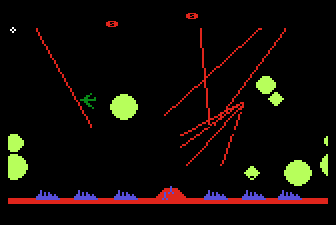
"In the dream, I'd see the missile streaks coming in and know that the blast would hit me." - Dave Theurer, speaking to Polygon
But unless the player's actions have an impact on that context - unless their engagement with the mechanics actually matters in some way - they do not truly have reason to care about the events any more than the viewer of a film does. This is more subtle than merely forcing the player to take fixed actions in gameplay. That artifice does not hold up emotionally. The player did not murder those townspeople; Arthas did. The player did not drop white phosphorous on those refugees; Captain Walker did. The designer forced them. The player had no actual choice (besides the eternal cop-out of "turn the game off").
Contrast that to Papers Please. The player controls an immigration officer in a communist dictatorship. Their choices directly impact who gets through and who doesn't. And they are allowed to make the choices that they do. There is no hand forcing the player reject innocents or deprive others of basic human dignity. The relatively simple mechanics (timed investigations and correlation of an increasingly complex number of rules) are elevated infinitely by the contextualization the game provides.

Imagine the same message being conveyed in passive media. The audience is shown this situation, given the necessary backstory, and watch this immigration officer try to do his job. It is not hard to imagine this character being reviled for his actions. But the film maker can address that2. Maybe there is time set aside to establish his struggles - a sick family, mounting bills. Maybe he is shown to be trying his best, skirting the rules as best he can to serve the moral good. Maybe he's Oskar Schindler, doing enough evil to maintain a cover while achieving something heroic.
Yet always - always! - there is a disconnect between the audience and the actor. The film must work hard to make the character seem anything more than a heartless bureaucrat. In doing so, it changes its focus; it becomes about this character and his response to the situation, rather than about the unfairness of the system and how the audience would respond when put into those circumstances.
Imagine if every story-meaningful decision that happened in Papers Please happened outside of the player's control. The writer decides if "you" let the pimp through the checkpoint, or if "you" accept a bribe. It becomes a different game entirely. The astute will immediately jump to the term that I'm dancing around, of course; ludonarrative dissonance. That isn't quite what I'm talking about. In Grand Theft Auto V, the player characters are portrayed as violent maniacs, exactly how many players actually do play. But the game falls flat as art, at least to me, because of ludic irrelevance; there is no way for me as a player to express my choices in a way that the game recognizes as meaningful. In especially poor examples, the designer even scripts the gameplay (though at this point we may as well call that Rockstar's house style).
The player plays in the sandbox, and next to them a blind author tells them what they have decided to do. And we call that art. It doesn't have to be that way, and we should pay more attention on those games that show us what artistic games can actually do.
Next week I'll dive deeper into successes and failures in creating meaning through mechanics with some more detailed case studies.
Not to deride non-artistic games. Sometimes, people want to just play something fun, without having it matter to them on a deep emotional level. Sometimes people just want to eat popcorn and watch big robots punch each other; why should they be expected to absorb art instead?
It can be done even unintentionally. There are people that think Humbert Humbert is a sympathetic character.